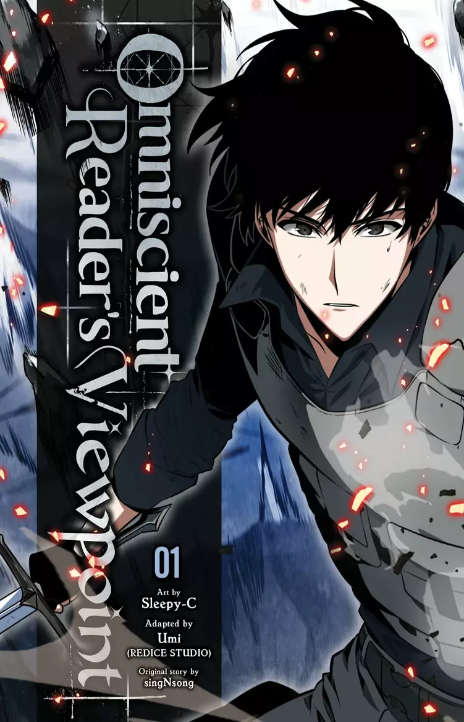
Omniscient Reader’s Point of View
Subway car 3-8 smells of recycled air and cheap coffee when the evening commute freezes mid-breath. Kim Dokja, a salaryman with a thin wallet and ten years of obsessive reading, still feels his smartphone vibrating in his fingers — the author's final notification, the end of the epic web novel "Three Ways to Survive in a Ruined World." Three thousand one hundred forty-nine chapters devoured, chapter by chapter, year by year, while the rest of the planet wrote him off as a ghost haunting the comment section. Then the power dies. A bodiless voice announces the start of the "scenarios," and a dokkaebi named Bihyung grins out of the void: kill something or die.
Dokja is no protagonist. He has no muscles, no hidden power, no shimmering blade — just the text file the author sent him moments before the world ended, and inside it every coming sentence of this apocalypse. He reads sideways while train cars ignite and passengers devolve into beasts, brute-forcing fate with nothing but foresight. But waiting on the Dongho Bridge is Yoo Junghyeok — the novel's protagonist, a regressor with eyes colder than forged steel who does not tolerate strangers in his timeline. Dokja lies, trades, and presents himself as a "prophet" just to earn his next breath. The omniscient reader has climbed inside the book. Yet the longer he rewrites the plot, the louder one question drums against his skull: who decides how the world ends — the author, the main character, or the reader who suddenly stands at the center of both?
Also known as: 전지적 독자 시점, Jeonjijeok Dokja Sijeom, Omniscient Reader's Viewpoint, ORV.